Camell Kachour
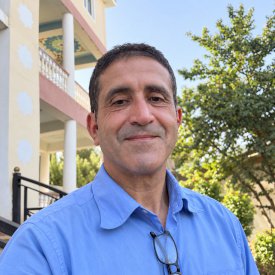
I am a mathematician and CNRS researcher at the Institut Mathématique d’Orsay, Université Paris-Saclay.
My main research interests lie on algebraic and operadic approach of higher category theory and homotopical structures, with a particular focus on globular and cubical approaches to higher categories.
More broadly, I am interested in the interactions between category theory, homotopy theory, logic, set theory, type theory, probability, and mathematical physics.
This website presents my research work, mathematical notes, talks, and some of the topics that currently shape my scientific interests.
Contact
Bureau 3M17
Laboratoire de mathématiques d'Orsay
Bât. 307
Université Paris-Saclay
91405 Orsay
+33 7 60 40 79 93
camell.kachour@gmail.com
Academic Biography
My scientific career has followed a highly unusual path, and it cannot easily be compared with a conventional academic career.
For a large part of my mathematical life, I worked without institutional funding and with very limited contact with the academic community. During years in which most researchers normally benefit from a university position, a research environment, regular seminars, collaborators, travel funding and financial security, I pursued mathematics largely on my own and under very precarious conditions.
The Internet played a decisive role in breaking this isolation. My first sustained contact with the international community of higher category theory came through Jacques Penon, with whom I began a long mathematical exchange. In 2007, I gave a first research talk in Paris, where I met Michael Batanin. The following year, at the CT2008 conference in Calais, I met Ross Street.
After that meeting, I told Ross that I wanted to work in Australia. Ross Street and Michael Batanin supported my application to Macquarie University, and in 2010 I was awarded an International Macquarie Research Excellence Scholarship. I then carried out my PhD research at Macquarie University, working within one of the leading groups in higher category theory.
After returning to France, however, I again found myself without a research position or regular funding. For several years I continued my mathematical work independently. In 2017, I received a short two-month postdoctoral position at IRIF. Later that year I was invited to the Institut des Hautes Études Scientifiques, where I worked in an environment around Maxim Kontsevich. During this period I developed important parts of my theory of cubical higher operads.
My work at the IHES attracted the attention and support of several senior mathematicians, in particular Maxim Kontsevich and Pierre Cartier. This period marked an important turning point in the institutional recognition of my research in France.
I began to receive stable research funding only very late in my career, and I joined the CNRS in 2020, at the age of fifty. Over roughly three decades of mathematical activity before that point, only a small fraction of my time had been supported by research funding.
This fact is important for understanding my scientific trajectory. Research funding is not merely financial support: it provides time, mobility, colleagues, seminars, access to institutions, and the possibility of sustained interaction with other mathematicians. For many years I was deprived of much of this infrastructure during precisely the period in which a scientific career would normally develop most rapidly.
I therefore do not regard my publication record or my academic chronology as directly comparable with those of researchers who followed a continuous institutional career. Much of my mathematical work was developed under conditions of isolation and financial insecurity, rather than within the normal framework of professional research.
At the same time, this unusual path profoundly shaped the way I do mathematics. I learned to work independently, to reconstruct theories from their foundations, and to pursue questions for long periods without immediate external validation. The research programme I continue to develop today — on higher transformations, higher operads, globular and cubical higher categories, and the algebraic foundations of higher-dimensional mathematics — has its origins in those years of independent work.